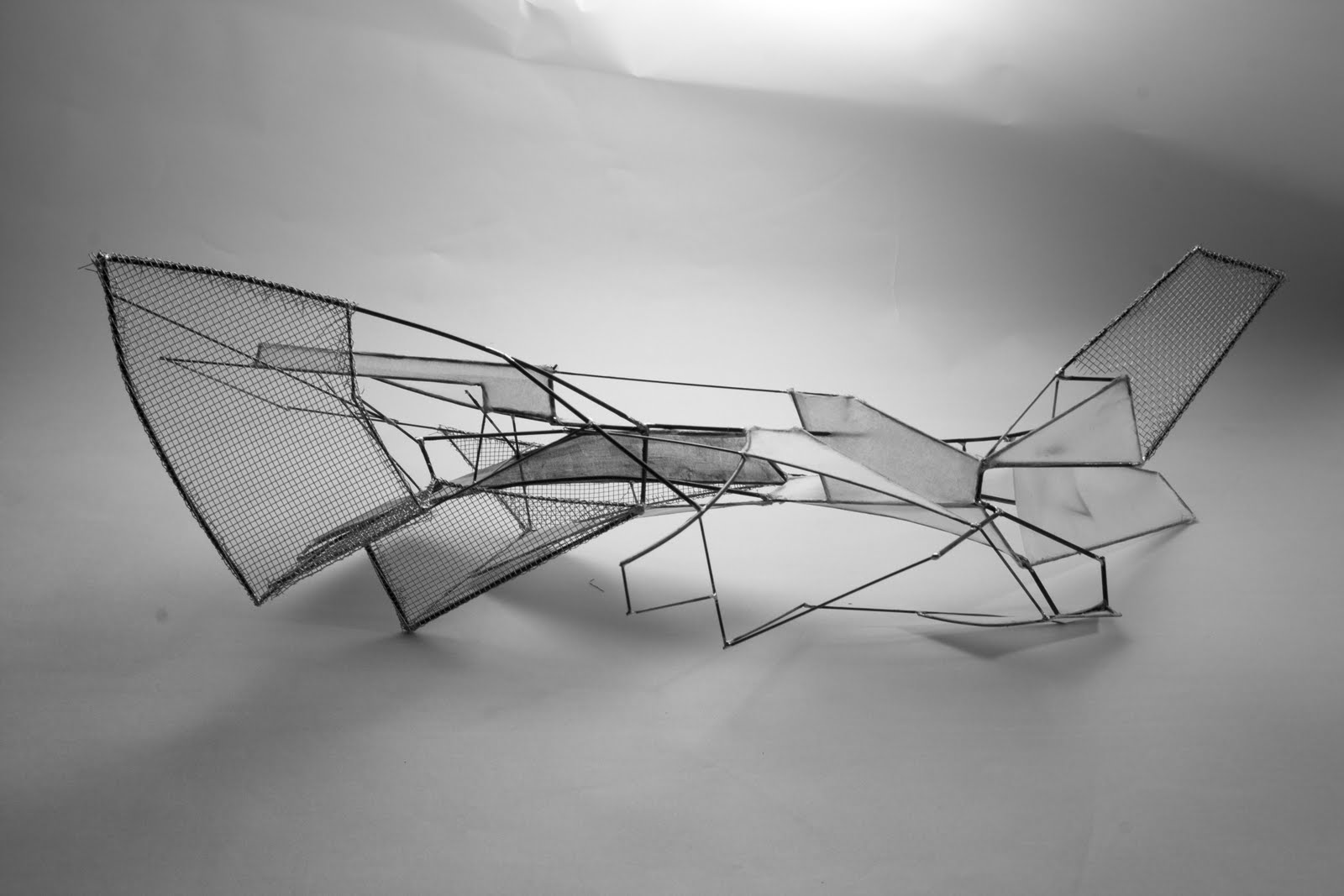
Project 1
School: Univeristy of Michigan
Class: UG1 (Architectural Design 1)
 |
| Gray Tree by Piet Mondrian |
The initial reaction to the Gray Tree might often be one of confusion; The brush strokes and unusual color patterns are hard for the brain to sew together into a recognizable image, the only discernible aspect amidst all its chaos becomes the central congregation of dark lines into a large shape that forces the mind to semi-comprehend a trunk with emanating branches.
The reason for the confusing nature of the painting is because it works reverse to reality, instead of recognizing the solid mass that it frames, it is recognizing the space that encompasses its surroundings. Every volume, streak, and profile that surrounds the shape of this "tree" is recognized and given three dimensional form alluding more to sets of fractures on a solid rather than tree.
The specific nature of a tree is that of a light construction versus dense occupation. The construction of its trunk, emanating form the starkly contrasting earth and then every one of its branches becoming lighter and more airy as they reach away from the trunk, force the recognition of a volume of air that exits under and in between each of its members rather than the tree itself. The only quality that allows the tree to read as a solid mass is found in its lightest elements, the leaves. The leaves enclose and provide a barrier from the surrounding spaces, a quality which highlights the volumes formed within its construction and communicates differently within the tree's volume than outside of it. In the Gray Tree, Piet Mondrian captures the spatial presence of the tree by solidifying those volumes it holds within its members, and instead of using leaves he uses darker shades, texture, and changes in color to provide the means to mass them.
This type of spatial recognition allows the viewer to freely assign depth to the volumes and read them in a variety of ways. Among the arguably dozens of ways that he treats the volumes within the tree, three can be easily recognized.
First, from the center to the leftmost edge of the frame it can be observed that the texture used on the surrounding volumes is that of grainy lines that move slightly offset from the vertical. This method of solidification of air volumes might indicate a different light condition, possibly harsher and more dense, than on the other areas.

Second, from the center to the rightmost edge of the frame we encounter a smoother more modulated approach to solidifying the air volumes. This method allows the stokes to follow the movement of the black lines or "branches" in a semi-dark shade while also using light patches of color to highlight small volumes. This might also indicate a different light condition, one that is filtered through elements such as leaves or the branches themselves as it emanates from left to right.

Lastly, when portraying the volume of the central dark element or "trunk" there are differences in shape that are attempted to be recorded through the use of lighter shades. These might serve as a transition between the conditions in the left and right of the painting, providing a visual connection across the central element and enriching the interpretation of how the volumes of air move around the tree.
Assignment:
Build up the given image in your considered fragments. With at least 8 layers, build up the image working from foreground to background. Decide which elements, and proportions of the spaces are in front or behind one another. What sort of depths are at play? What is the mass? Maintain the forms and feel of the starting image, but be inventive with the figures. Set rules of translation such as: is a dark form a solid? What does the grain of the grey mean to the form? What is near? Far? A diagonal? The edge?
Well, on to modeling...